

The DIY thread - DIYourself

They are on sale this week at Costco, the 12k btu model. I recently bought two rolling units from Costco as well. The Hisense is smaller and also has a heat pump option, but the hose setup is really sloppy. The other, is from Danby, it's bigger but the hose is much cleaner and can be flush to the wall. Both are fairly loud and didn't really think about it till trying to watch TV today with it on. The Midea U models are supposed to be relatively quiet and will help since the window is adjacent to the TV.

Thinking to keep the Danby as I like the hose layout better. But it doesn't have heat options like the Hisense.
I liked the idea of the U-shaped window unit as it really won't take up much space (it's not on the floor) and the window is much more shut so the sealing should be way better plus more secure in the window as opposed to a @SmooveP death trap situation.

Plus all the benefits of the new inverter units, it being really quiet.

I have very little experience with these but I stayed in an AirBnB for a week before we moved into this house and they had a split unit in the bedroom and the main room. I was blown away how quiet they ran that I kept thinking they were off. They were in heat-pump mode with the fan blowing air into the room and couldn't even tell they were on.

It helps that they can run with very low fan speed and low heat/cooling as opposed to an ON/OFF situation of typical units.
 
I'm now getting FB ads for "MrCool"mini-splits... no special tools required. It's on the internet, so must be legit.

once the hole is in the wall, electric and the lines run, it is probably cheaper to buy a sub $1k unit every 5 years.
I may do one in upstate NY - mostly for the dehumidification in a basement.
 
once the hole is in the wall, electric and the lines run, it is probably cheaper to buy a sub $1k unit every 5 years.
I may do one in upstate NY - mostly for the dehumidification in a basement.
Why not just a de-humidifier?....
 
I liked the idea of the U-shaped window unit as it really won't take up much space (it's not on the floor) and the window is much more shut so the sealing should be way better plus more secure in the window as opposed to a @SmooveP death trap situation.

Plus all the benefits of the new inverter units, it being really quiet.

I have very little experience with these but I stayed in an AirBnB for a week before we moved into this house and they had a split unit in the bedroom and the main room. I was blown away how quiet they ran that I kept thinking they were off. They were in heat-pump mode with the fan blowing air into the room and couldn't even tell they were on.

It helps that they can run with very low fan speed and low heat/cooling as opposed to an ON/OFF situation of typical units.
There are also over-the-sill models that are U-shaped, kinda the inverse of the Midea. All of my windows are sliders, so my options are limited. The rolling unit plays nice with them - don't even have to remove the screen and can open the window without removing the hose panel.
 
Why not just a de-humidifier?....
Wrestled with this at the cabin.
Settled on AC set at like 80ish, worked like a champ, didn’t have to worry about drain lines, and ac is less likely to burn the house down while we’re away.

Plus it works as an ac which is helpful in the summer.
 
Wrestled with this at the cabin.
Settled on AC set at like 80ish, worked like a champ, didn’t have to worry about drain lines, and ac is less likely to burn the house down while we’re away.

Plus it works as an ac which is helpful in the summer.
You wrestled a dehumidifier? Who won?
@Shaggz and I might wrestle my AC unit this weekend. Too bad you're not around to video it.
 
Not often when the DIY plan goes according to plan. This one was a team effort with my 20 year old middle son (soon to be 21 next month) who has some good basic professional experience with electrical stuff.

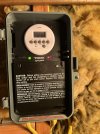
Todays job was to replace the indoor mechanical pool timer with a digital one. I had replaced this timer like for like last year mostly because the wiring was the same. But after the 2nd one broke in less than one season, I bought this one right around when I closed the pool in September so I never installed it.

When I opened up the new one to compare the old one the wiring was nothing alike. I know enough about basic wiring to not mess it up but can easily defer to the son who might know better.

After we checked some YouTube videos and he found an exact picture by picture article online how to do it, we were good to go. Only one trip out to two different stores to get some 12gauge wire for jumpers and some extra wire nuts.

Once we had everthing planned out it was just a matter of lining up the new box and making sure the wires reached the little ports. As it turns out we wired it better without combining and using wire nuts since this new design accommodated up to 3 wires per port.
So we combined the wires where possible into the ports. Same for the ground wire instead of trying to twist into a wire nut.

Before and after pics etc. good little father son project and when we turned on the breaker everything works as expected no tripped breaker. Programmed the on off times now just have to see if that works later when it’s set to turn off. DC752059-E43B-4D1F-B335-F3F961A24E6D.jpeg50B21826-B84A-4C4B-90B1-FB1FB0C95085.jpeg20DA88DE-DBD6-41FD-8721-02D3BF28F298.jpeg0FD8FCC9-FB49-42FB-A8BB-5DF9295E1ECF.jpegF8C6B52F-CCAF-4B59-8AA3-8740733FED41.jpeg4E3AB816-52CB-4365-AB3B-4727B462319D.jpeg6D1BABEE-F7B1-4B91-ADD4-8D3F0FF74F02.jpeg
 
Not often when the DIY plan goes according to plan. This one was a team effort with my 20 year old middle son (soon to be 21 next month) who has some good basic professional experience with electrical stuff.

Todays job was to replace the indoor mechanical pool timer with a digital one. I had replaced this timer like for like last year mostly because the wiring was the same. But after the 2nd one broke in less than one season, I bought this one right around when I closed the pool in September so I never installed it.

When I opened up the new one to compare the old one the wiring was nothing alike. I know enough about basic wiring to not mess it up but can easily defer to the son who might know better.

After we checked some YouTube videos and he found an exact picture by picture article online how to do it, we were good to go. Only one trip out to two different stores to get some 12gauge wire for jumpers and some extra wire nuts.

Once we had everthing planned out it was just a matter of lining up the new box and making sure the wires reached the little ports. As it turns out we wired it better without combining and using wire nuts since this new design accommodated up to 3 wires per port.
So we combined the wires where possible into the ports. Same for the ground wire instead of trying to twist into a wire nut.

Before and after pics etc. good little father son project and when we turned on the breaker everything works as expected no tripped breaker. Programmed the on off times now just have to see if that works later when it’s set to turn off. View attachment 215548View attachment 215549View attachment 215550View attachment 215554View attachment 215555View attachment 215556View attachment 215557

this is 110/120 yes?

holy hell. @Mtbdog - i see a 220 timer with a live leg tied like a neutral.
instead of going to L1, L2, it is jumped around. so it "works"

if it is 220
power should come to L1 and L2, load should be tied to NC1, NC2 ?

There are many ways to make it work, doesn't mean it is right.
 
this is 110/120 yes?

holy hell. @Mtbdog - i see a 220 timer with a live leg tied like a neutral.
instead of going to L1, L2, it is jumped around. so it "works"

if it is 220
power should come to L1 and L2, load should be tied to NC1, NC2 ?

There are many ways to make it work, doesn't mean it is right.
Why are you assuming it's 220V?

The wiring is Black/White. The new timer is 120-277V rated. I'd assume it's all 120VAC
Looks wired up exactly as I would expect. Line 120V is on L1 and is jumped to the switch Common. NO is the Normally Open contact to the load, 120VAC.

L2 is Neutral jumped to the Neutral of the load.
 
Why are you assuming it's 220V?

The wiring is Black/White. The new timer is 120-277V rated. I'd assume it's all 120VAC
Looks wired up exactly as I would expect. Line 120V is on L1 and is jumped to the switch Common. NO is the Normally Open contact to the load, 120VAC.

L2 is Neutral jumped to the Neutral of the load.
Thanks guys it’s all 120v

Double and triple checked it online and with the manufacturer video.

This timer does have a setup for 220 but we saw right away and I already knew frlm
The previous timer we didn’t need to wire it that way. Also the panel is clearly labeled 120


Thanks for the concern @Patrick and the confirmation @Santapez
 
Why are you assuming it's 220V?

The wiring is Black/White. The new timer is 120-277V rated. I'd assume it's all 120VAC
Looks wired up exactly as I would expect. Line 120V is on L1 and is jumped to the switch Common. NO is the Normally Open contact to the load, 120VAC.

L2 is Neutral jumped to the Neutral of the load.

220 does not require a neutral, and i immediately thought pool pump - but pool pumps aren't always 220 either...
the two neutrals tied to L2 are probably providing power/circuit for the timer.

I see your point that it is just a timer controlling relay, power to C on the hot leg, and controlled device on the NO - (def not NC like i said)
if it were 220, the other hot leg would use the second relay on the right ???
 
I think it would work fine wired the same way with 220. Though I guess you could separate L1 and L2 with separate relays.

it would work - problem is it would leave a hot leg at the load even when off.
need a double pole switch - which the second relay provides.
As Steve reminded me - the L!/L2 lines are not connected to the output of the relays - the power needs to go to the C lug,
and is then jumped to the NC/NO as labeled.

This allows the timer to run on a low voltage, and control a high voltage. You know this from things like contactors.
 
it would work - problem is it would leave a hot leg at the load even when off.
need a double pole switch - which the second relay provides.
As Steve reminded me - the L!/L2 lines are not connected to the output of the relays - the power needs to go to the C lug,
and is then jumped to the NC/NO as labeled.

This allows the timer to run on a low voltage, and control a high voltage. You know this from things like contactors.
I know. I just didn't see a problem with leaving the hot leg out there. Assuming the pump is hardwired and not plugged into an outlet.
 
it would work - problem is it would leave a hot leg at the load even when off.
need a double pole switch - which the second relay provides.
As Steve reminded me - the L!/L2 lines are not connected to the output of the relays - the power needs to go to the C lug,
and is then jumped to the NC/NO as labeled.

This allows the timer to run on a low voltage, and control a high voltage. You know this from things like contactors.
Yeah, this is really just a relay/contactor with a timer function.

If it was 220V or so you would wire it similarly but use the second relay connect on the right to break the L2 hot.

L2 would be the second hot and it would jump to C on the second output.

Now I want to buy one if these and hand it to people in job interviews and ask how they would wire it.
 
Back
Top Bottom