The DIY thread - DIYourself

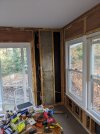
Luckily we've been having a heat wave so working on this room was sort of pleasant. Much easier to work in the 60s/70s vs 30s/40s. I caulked up the remaining seams last night and will get to putting up the walls eventually. Need to take a break from it for a bit. Went overboard sealing seams and shoving rockwool into tiny tiny gaps before sealing.

Found some rotted wood near the doors and a weird brick wall. Cleaned that up as best I could, put in some new cedar w/ mold/mildew paint/primer coating it.

Ended up moving around an outlet that's turned on from the wall switch inside the house and adding two outlets in better spots. Also future proofed it so if I get up in the attic area and do ceiling lights or whatnot I can easily convert the switched outlet to regular.

It's eery how quiet it is in there.

2025-12-26 15.59.43.jpg


2025-12-29 10.12.39.jpg

2025-12-29 10.12.50.jpg
 
Late to this, but sometimes it's required to install drywall under wood paneling for fire resistance. Depends on local code and flame spread rating of the paneling. Padding out trim to accommodate the different wall thickness is a bit of a pain, but not that hard to do. Rip a bunch of 3/4 pine. You can pre-paint it before you nail it up.
Ugh, now you're making me wonder if I should pad out the window casings and just go drywall. I have to touch-up paint them anyway so putting 1/2" strips or so all around the windows likely wouldn't be that hard. And it would make the wall/ceiling molding easier as I wouldn't have to worry about the existing parting line from when I took off the molding.

Not really concerned with codes. We purchased the house with wood paneling in here so putting new paneling in here would be fine. Probably way more fire resistant with the rockwool right now. I'd more concerned about the wood panels on the wall of the garage and the chip board ceiling in the garage.
 
Ugh, now you're making me wonder if I should pad out the window casings and just go drywall. I have to touch-up paint them anyway so putting 1/2" strips or so all around the windows likely wouldn't be that hard. And it would make the wall/ceiling molding easier as I wouldn't have to worry about the existing parting line from when I took off the molding.

Not really concerned with codes. We purchased the house with wood paneling in here so putting new paneling in here would be fine. Probably way more fire resistant with the rockwool right now. I'd more concerned about the wood panels on the wall of the garage and the chip board ceiling in the garage.
Yeah, it just gets down to aesthetics at this point. 75% of my house had wood paneling over sheetrock. I ripped most of it out and went with straight sheetrock. I left one bedroom paneled because it kinda looks cool. Repainted it. I replaced all of the windows and trim inside and outside the house, so padding out was a minor effort in comparison. Shoulda chronicled it here for entertainment. Too late now, mostly done!
 
Yeah, it just gets down to aesthetics at this point. 75% of my house had wood paneling over sheetrock. I ripped most of it out and went with straight sheetrock. I left one bedroom paneled because it kinda looks cool. Repainted it. I replaced all of the windows and trim inside and outside the house, so padding out was a minor effort in comparison. Shoulda chronicled it here for entertainment. Too late now, mostly done!
You almost had me, but then I realized if I just throw up new paneling it'll look fine and be WAY easier than sheetrock.

No way I'd do paneling over sheetrock, that's weird 70s stuff.
 
@FitmanNJ saw these in Costco, I'm considering them for my listening room. Four 2' x 2' panels, about 15.5 sqft for $50View attachment 273941
Hi, Walt. The value of these panels would depend on what you're seeking to improve. With the relatively thin panel depth and wooden slats on the front, these wouldn't have any meaningful effect on lower midrange and bass acoustics (the common issue being "boomy" or "mushy" bass).

These panels would be termed, "diffusors," and are best used for preventing reflected high(er) frequencies from "competing" with unreflected, direct sound since they arrive at the ear at slightly different times (reflected later than direct). This can "smear" the high frequency sound quality. They are most commonly mounted at "first reflection points," i.e., on the sidewalls or ceiling. You can use a mirror placed against the wall/ceiling while in the listening position to locate these "first reflection points" (where the speaker is visible in the mirror). The depth between the slats determines the frequencies "diffused"; with the shallow depth of these (seen some 6" deep between the slats), I would imagine that they wouldn't diffuse frequencies below 1200Hz (say, 1200-2500Hz), but I'm really just guessing here (could start even higher). Perhaps the box mentions the targeted frequencies? Needless to say, the price is much lower than the deeper, "tuned" versions, so that's a plus if they work.

Thanks to your generously giving me one of your table saws, I've completed my bass trap project and will be writing it up soon. I really went for it...and I've been very pleased with the results. When you see the size of these new traps, though, you won't have any trouble understanding why the Costco diffusers wouldn't be effective for bass issues...and why my having a spouse has become a total impossibility at this point!😀
 
Hi, Walt. The value of these panels would depend on what you're seeking to improve. With the relatively thin panel depth and wooden slats on the front, these wouldn't have any meaningful effect on lower midrange and bass acoustics (the common issue being "boomy" or "mushy" bass).

These panels would be termed, "diffusors," and are best used for preventing reflected high(er) frequencies from "competing" with unreflected, direct sound since they arrive at the ear at slightly different times (reflected later than direct). This can "smear" the high frequency sound quality. They are most commonly mounted at "first reflection points," i.e., on the sidewalls or ceiling. You can use a mirror placed against the wall/ceiling while in the listening position to locate these "first reflection points" (where the speaker is visible in the mirror). The depth between the slats determines the frequencies "diffused"; with the shallow depth of these (seen some 6" deep between the slats), I would imagine that they wouldn't diffuse frequencies below 1200Hz (say, 1200-2500Hz), but I'm really just guessing here (could start even higher). Perhaps the box mentions the targeted frequencies? Needless to say, the price is much lower than the deeper, "tuned" versions, so that's a plus if they work.

Thanks to your generously giving me one of your table saws, I've completed my bass trap project and will be writing it up soon. I really went for it...and I've been very pleased with the results. When you see the size of these new traps, though, you won't have any trouble understanding why the Costco diffusers wouldn't be effective for bass issues...and why my having a spouse has become a total impossibility at this point!😀
Ha, I stand corrected based on a YouTube video just posted. This guy knows his stuff. If sounds like the Costco product isn't what I called a diffuser but more an absorber. Either way, though, the impact is limited to high(er) frequencies:
 
As is probably pretty obvious at this point, I really love listening to recorded music. Over the last couple of years, I've begun installing acoustic panels with the hope of improving the sound quality in my modest living room. The layout/construction of the room gives you every reason to assume that, "as is," it leaves a lot to be desired.

Microphone measurements have proved this to be true, particularly with regard to bass frequencies. So called "spectrogram" graphs measure the length of time it takes for tones across the frequency spectrum to dissipate. Although there's no totally agreed upon definition of ideal, many audiophiles would suggest that a spectrogram showing a roughly horizontal line at between 200-300 milliseconds would typically be desirable -- not echoey, and not too "dry"/lifeless. Although sounding subjectively quite good, my room measured as follows at the start of this latest "journey" -- pretty flat down to ~100Hz, but a little ragged below 100Hz (the far left in the graph):

Before Spectrogram.jpg

About three month's ago, I read about a new commercial bass trap product that was being touted as bigger and better at bass control than others previously available. While investing in a whole new set of these panels would have been prohibitively expensive, I wondered if I could possibly modify what I already had at a much more affordable price but with similar impact on the room acoustics. AND...about that same time, Walt (@qclabrat) generously offered a spare table saw for free to anyone willing to pick it up. Feeling a sense of karma,🙂 I reached out to Walt.

Modeling after the "super" bass traps that had just been advertised, I planned to take my existing 6" deep bass traps and essentially double their depth. Additionally, I replaced the absorptive material in these expanded bass traps with a combination of acoustic insulation and pink fiberglass (6" of each) touted to be a superior design per an online acoustic modeling application. The final enhancement was to mount these monsters with a 6" air gap between the panel and the wall, another "trick" for improving bass control.

The following photos illustrate how I implemented this plan. First, the materials -- Rockwool Comfortbatt insulation, Owens Corning Pink Fiberglass, and rectangular wooden frames to "extend" the depth of the existing panels:

1767144858252.jpeg

1767144633887.jpeg

Steps 1 & 2: Build out the existing bass trap with the rectangular wooden frame and replace the old acoustic insulation material with the Comfortbatt:

1767145158961.jpeg

Add the pink fiberglass:

1767145239575.jpeg

Add some wooden strips across the back of the assembly to help hold in the absorptive materials (not shown), then cover the back with landscaping fabric:
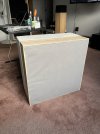
1767145489700.jpeg

I then repeated that something like 15 times, including two panels that I built from scratch. I mounted them with 6" air gaps using ~6" long wooden spacers (see panels on the side walls). The panels straddling the ceiling were not modified:

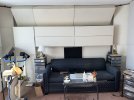
1767146172523.jpeg

1767146219071.jpeg

1767146253709.jpeg

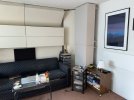
The panels and couch/listening position all face the stereo equipment:

1767148925462.jpeg

I've hit the limit on attachments, so see the next post for the latest spectrogram. It's NOT perfect, which just illustrates how difficult it is to impact low-end acoustics in a small room. But, there has been a noticeable improvement.

Of course, the bottom line is, "How does it sound?" For that, I can say that the lows are crisp and the imaging of the sound stage is improved. I've been truly delighted with the result! I couldn't have done this without that table saw -- thanks so much, Walt!

 
Last edited:
Back
Top Bottom