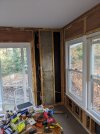
As is probably pretty obvious at this point, I really love listening to recorded music. Over the last couple of years, I've begun installing acoustic panels with the hope of improving the sound quality in my modest living room. The layout/construction of the room gives you every reason to assume that, "as is," it leaves a lot to be desired.
Microphone measurements have proved this to be true, particularly with regard to bass frequencies. So called "spectrogram" graphs measure the length of time it takes for tones across the frequency spectrum to dissipate. Although there's no totally agreed upon definition of ideal, many audiophiles would suggest that a spectrogram showing a roughly horizontal line at between 200-300 milliseconds would typically be desirable -- not echoey, and not too "dry"/lifeless. Although sounding subjectively quite good, my room measured as follows at the start of this latest "journey" -- pretty flat down to ~100Hz, but a little ragged below 100Hz (the far left in the graph):

About three month's ago, I read about a new commercial bass trap product that was being touted as bigger and better at bass control than others previously available. While investing in a whole new set of these panels would have been prohibitively expensive, I wondered if I could possibly modify what I already had at a much more affordable price but with similar impact on the room acoustics. AND...about that same time, Walt (
@qclabrat) generously offered a spare table saw for free to anyone willing to pick it up. Feeling a sense of karma,
🙂 I reached out to Walt.
Modeling after the "super" bass traps that had just been advertised, I planned to take my existing 6" deep bass traps and essentially double their depth. Additionally, I replaced the absorptive material in these expanded bass traps with a combination of acoustic insulation and pink fiberglass (6" of each) touted to be a superior design per an online acoustic modeling application. The final enhancement was to mount these monsters with a 6" air gap between the panel and the wall, another "trick" for improving bass control.
The following photos illustrate how I implemented this plan. First, the materials -- Rockwool Comfortbatt insulation, Owens Corning Pink Fiberglass, and rectangular wooden frames to "extend" the depth of the existing panels:


Steps 1 & 2: Build out the existing bass trap with the rectangular wooden frame and replace the old acoustic insulation material with the Comfortbatt:

Add the pink fiberglass:

Add some wooden strips across the back of the assembly to help hold in the absorptive materials (not shown), then cover the back with landscaping fabric:
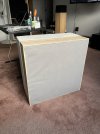
I then repeated that something like 15 times, including two panels that I built from scratch. I mounted them with 6" air gaps using ~6" long wooden spacers (see panels on the side walls). The panels straddling the ceiling were not modified:

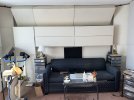
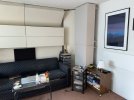
The panels and couch/listening position all face the stereo equipment:

I've hit the limit on attachments, so see the next post for the latest spectrogram. It's NOT perfect, which just illustrates how difficult it is to impact low-end acoustics in a small room. But, there has been a noticeable improvement.
Of course, the bottom line is, "How does it sound?" For that, I can say that the lows are crisp and the imaging of the sound stage is improved. I've been truly delighted with the result! I couldn't have done this without that table saw -- thanks so much, Walt!